 Throw a frog in a pot of boiling water and it will instantly jump out, terrified (and very hot). But put it in a pot of cool water and slowly increase the heat to boiling and it will stay there until it dies. Gruesome? Yes. But a useful analogy for the music industry? Also ‘yes.’ Crucially, the cultural costs were neither as visible nor impactful at the start, instead creeping up over time until suddenly they became the fault lines of today’s business.
Marketplace
‘Efficiency over artistic merit’: The crossover between art and artificial intelligence
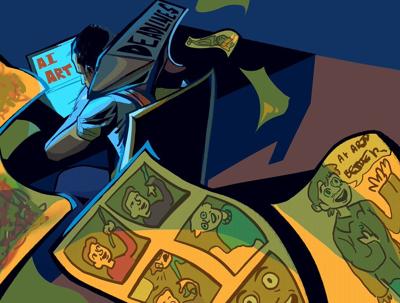 As artificial intelligence becomes increasingly involved in art, ethical and societal concerns have emerged about AI’s place in creative work. “The capitalist era that we live in favors efficiency over artistic merit,” third-year art student Josue Herrera said. Depending on the intricacy of the prompt, the AI model, the size of the creation and other factors, AI can generate a piece of artwork anywhere from a few seconds to a few hours. Meanwhile, digital creators can take months to finish a piece.
Source: ‘Efficiency over artistic merit’: The crossover between art and artificial intelligence
Microsoft, Amazon Plan AI Content Marketplaces
 Amazon joins Microsoft, which recently launched Publisher Content Marketplace, in developing platforms to allow publishers to license content and be paid-per-use, rather than by offering an blanket, up-front fee. The two tech giants are not operating in a vacuum, as a variety of companies have been racing to establish their their own licensing platforms.
Hollywood Braces for New Round of Labor Talks
 The sides will be negotiating in a Hollywood far different from 2023. Production has slowed significantly industrywide, as many entertainment companies struggle to adjust to the streaming world. Work has dried up for many actors, writers and directors. At the same time, the rise of generative artificial intelligence has become more central.
ElevenLabs, Valued at $11 Billion, ‘Doubles Down’ on Audiobooks
 ElevenLabs, the company that offers automated AI-voice generated audiobook production, has consolidated their services under the brand Audiobooks in ElevenCreative. The move signals the well-funded company’s commitment to the sector, or what Madeline Shue, head of growth and publisher partnerships at ElevenLabs, called a “doubling-down on audiobooks.”
Source: ElevenLabs, Valued at $11 Billion, ‘Doubles Down’ on Audiobooks
The New Fabio Is Claude
 The genre may be especially vulnerable to disruption by A.I., for all the reasons that readers love it. Romance relies on familiar narrative formulas, like the guarantee of an “H.E.A.” or “happily ever after.” And romance novels are often built around popular plot tropes — like enemies-to-lovers or forced proximity — that can be fed into a chatbot.
Source: The New Fabio Is Claude
Christopher Nolan Wants to Know Where All the Hollywood Jobs Are, Too
 During Nolan’s first interview about the role, he shed light on his approach to labor negotiations, AI and corporate consolidation, all while emphasizing that one of his top focus areas is boosting employment in the industry. Nolan said early on that he wants to explore the gap between consumer spending on entertainment and industry jobs with employers.
Source: Christopher Nolan Wants to Know Where All the Hollywood Jobs Are, Too
Adobe’s Hollywood Strategy Comes Into Focus
 This week, Adobe confirmed a slate of partnerships tying its generative AI platform — Firefly and the Firefly Foundry initiative — directly into entertainment and advertising workflows, including collaborations with major talent agencies and production entities. The message was subtle but unmistakable: Adobe doesn’t want to disrupt Hollywood. It wants to supply it.
Source: Adobe’s Hollywood Strategy Comes Into Focus — AI In Hollywood
Apple says it demonetised 2bn fraudulent music streams in 2025
 Apple Music identified and demonetised up to 2bn fraudulent streams last year according to longtime exec Oliver Schusser. “Streaming manipulation on our platform is already incredibly low. We literally have systems where we check and validate every single play on Apple Music,” claimed Schusser. “When we find fraud we remove the stream counts, we remove from the charts, and we take the money and put it back into the pool so that it goes to honourable artists.
Source: Apple says it demonetised 2bn fraudulent music streams in 2025
AI ‘slop’ is transforming social media – and there’s a backlash
 Meta, which runs social media sites Facebook, Instagram and Threads, is not only allowing people to post AI generated content – it’s launched products to enable more of it to be made. “Soon we’ll see an explosion of new media formats that are more immersive and interactive, and only possible because of advances in AI,” Zuckerberg said.
Source: AI ‘slop’ is transforming social media – and there’s a backlash