 One music industry strategist thinks so, arguing in a provocative new essay that the streaming giant should implement a 250,000 monthly listener threshold to concentrate payments among professional musicians who can earn a sustainable living. The proposal comes as Spotify moves in the opposite direction for podcasters, slashing its Partner Program eligibility requirements by half.
SAG-AFTRA’s Likely Strategy: Make AI Performers as Expensive as Humans
 The national executive director and chief negotiator of the actors union SAG-AFTRA enumerated on his dollars-and-cents approach to what the labor group calls “synthetic performers” in an interview at the Consumer Electronics Show on Thursday. His remarks previewed the tack that the union may take when its negotiations with studios and streamers begin on Feb. 9, where AI is again expected to be a top issue.
Source: SAG-AFTRA’s Likely Strategy: Make AI Performers as Expensive as Humans
French Court Orders Google to Block Pirate Sites, Dismisses ‘Cloudflare-First’ Defense
 The Paris Judicial Court has ordered Google to block nineteen additional pirate site domains through its public DNS resolver. The blockade was requested by Canal+ and aims to stop pirate streams of Champions League games. In its defense, Google argued that rightsholders should target intermediaries higher up the chain first, such as Cloudflare’s CDN, but the court rejected that.
X Sues Music Publishers Over “Weaponized” DMCA Takedown Conspiracy
 Elon Musk’s X Corp. filed a landmark antitrust complaint against the NMPA, Sony, Universal, and other major music publishers, claiming that they used a coordinated “extortionate campaign” to force licensing deals. The lawsuit alleges that a flood of “baseless” DMCA notices targeted over 200,000 posts and suspended 50,000 users, allegedly to coerce X to sign industry-wide agreements.
Source: X Sues Music Publishers Over “Weaponized” DMCA Takedown Conspiracy * TorrentFreak
11th Cir.: YouTube not required to run Content ID to preserve DMCA safe harbor
 YouTube was entitled to seek protection from the safe harbor provision of the Digital Millennium Copyright Act even though it had, but did not deploy, technology capable of identifying matches between videos identified in takedown requests and videos with similar content elsewhere on its service, the U.S. Court of Appeals for the Eleventh Circuit has held.
Source: 11th Cir.: YouTube not required to run Content ID to preserve DMCA safe harbor
Anthropic reportedly raising $10B at $350B valuation
 Anthropic is gearing up to raise a fresh $10 billion at a $350 billion valuation, according to The Wall Street Journal. TechCrunch has confirmed the raise and valuation, according to a person familiar with the matter. The Claude maker last raised a $13 billion Series F round at a $183 billion valuation three months ago, so this raise nearly doubles the AI firm’s value. In March, Anthropic secured $3.5 billion at a $61.5 billion valuation.
Source: Anthropic reportedly raising $10B at $350B valuation | TechCrunch
‘This isn’t about limiting fan creativity. It’s about ensuring creators and rights-holders are paid.’
 If trained professionals can’t reliably detect AI, everyday listeners won’t either. The behaviour is stable and repeatable. Millions search for and share AI covers and remixes daily. That consistency is the basis of every revenue line the industry has ever built. What’s missing is licensed infrastructure. The biggest short-term commercial opportunity is AI cover versions and remixes.
UMG’s latest major AI partnership arrives via tech giant NVIDIA
 The world’s largest music rights company announced Tuesday (January 6) a strategic collaboration with AI computing giant NVIDIA, the world’s most valuable company by market capitalization, currently valued at approximately $4.56 trillion. According to a press release, the partnership will see NVIDIA and UMG “undertake collaborative research and development to promote shared objectives of advancing human music creation and rightsholder compensation.”
Interactive AI Features in E-books, Audiobooks Drive Debate
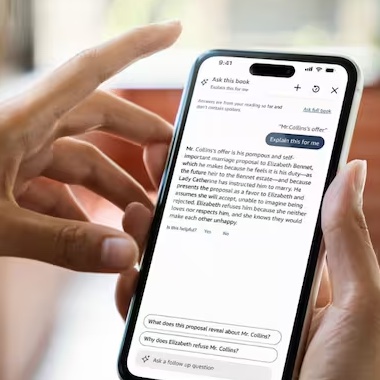 Amazon’s “Ask this Book” and ElevenLabs’ “VoiceChat” features add a new layer of AI-powered interactivity between books and readers—and raise questions about the legality and reliability of such tools. “‘Ask this Book’ is designed as a reading comprehension tool for customers who have already purchased or borrowed books, providing factual information to help them better understand what they’re reading, with answers that are non-shareable and non-copyable,” an Amazon spokesperson told PW.
Source: Interactive AI Features in E-books, Audiobooks Drive Debate
The Question of AI and Copyright Infringement is Actually an Easy One
 Much of the focus on generative artificial intelligence (GenAI) has been on training data ingestion—the moment when AI “steals” from creators. But legally, that’s not where the real fight should be. No new formulation of copyright law by Congress, as suggested by some academics, is necessary. By considering these seven unique aspects of GenAI systems, copyright analysis is actually easy.
Source: The Question of AI and Copyright Infringement is Actually an Easy One