
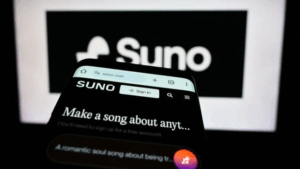
 Jason Isbell is suing AI music company Suno over the alleged commercial use of his identity. The six-time Grammy winner filed a proposed class action on Monday (August 31) in Boston federal court, alongside Cracker and Camper Van Beethoven frontman David Lowery, Texas blues musician Guy Forsyth, and Florida saxophonist Eduardo Calle. Interestingly, the 84-page lawsuit contains no copyright claim.
Source: Jason Isbell and David Lowery are suing Suno in a class action suit
 Over the last ten years, buying music became trendy. The logic was simple: recurring revenue, long duration, emotional resonance. Prices climbed. Multiples stretched. Everyone wanted to jump on the bandwagon. Then the market said enough. The collapse of the Hipgnosis Songs Fund looked, for a moment, like a verdict on music as an asset. It was not. It was a verdict on an over-leveraged fund. Content underneath it was just fine. Music is still the name of the game. What came next proved the point.
 Tech giant Google has been quietly making overtures to the major studios as it tries to find ways to entice Hollywood to use its artificial intelligence technology. Google executives have approached representatives at Disney, Universal, Warner Bros. Discovery and other studios about licensing intellectual property to be used in AI models, according to three people familiar with the conversations who were not authorized to speak publicly about them.
 A group of more than 80 performers, including actor Hugh Bonneville and singer Sandi Thom, have written to the UK government to demand greater protection against their voices being used by AI. Together, they are asking Prime Minister Andy Burnham to introduce legislation that would better protect every person in the UK against voice cloning and AI training on recordings without consent. Audiobook narrator Alice Sockett co-founded the campaign, calling voice cloning “an existential threat to our entire industry.”
 A study commissioned by the Gotham Ghostwriters and Bernoff.com found that while most professional writers are embracing AI tools, authors, specifically fiction authors, are much more wary. The majority of all writers think that AI poses both a threat and an opportunity. 61% reported using AI tools, which they say increase their productivity by an average of 31%, but only 7% of respondents have published AI-generated text.
 A new report from the UK Department for Culture, Media, and Sport on the impact of Brexit on British musicians playing in Europe reveals that the UK leaving the EU in 2020 has had a significant effect on European touring for UK musicians. In particular, the study highlights the decline in performances and estimates the economic consequences. Commissioned by the UK government, the report reveals that the total number of performances by British artists in Europe in 2024 was 21% lower than pre-Brexit levels in 2019.
 In something of a first, Google has launched a new AI application for books that publishers seem to actually like, thanks to its apparent respect for copyright protections. Today, the company introduced Expert Intelligence (EI), a feature that allows someone reading an e-book purchased on Google Play’s e-bookstore to interact with the title—by asking questions about the book, taking a quiz after reading it, or producing an infographic of key data—through Google’s AI research tool, Gemini Notebook.
 Sony Music Publishing and Warner Chappell Music have joined forces to sue Anthropic, home of Claude, over what the publishers call “one of the largest and most blatant ongoing thefts of intellectual property in history.” The complaint also names Anthropic Co-Founder and Chief Executive Officer Dario Amodei and Co-Founder Benjamin Mann as individual defendants. It was filed on Friday (August 28) in the US District Court for the Northern District of California.
 Imagine a scenario where a documentary filmmaker, in the course of making the documentary, captures some damning footage of corporate malfeasance, which she wishes to share with an investigative reporting organization anonymously. Should we be concerned that mandates on AI watermarking might reveal who she is, even if she’s not using AI at all? This doesn’t mean that watermarking shouldn’t be used, but rather, as WITNESS notes, we should be aware of the risks, and seek to counter them.