
Data

Bots are overwhelming websites with their hunger for AI data

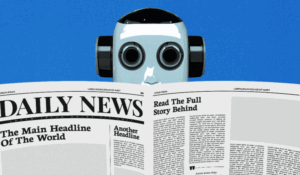
Bots harvesting content for AI companies have proliferated to the point that they’re threatening digital collections of arts and culture. Galleries, Libraries, Archives, and Museums (GLAMs) say they’re being overwhelmed by AI bots according to a report issued on Tuesday by the GLAM-E Lab. The surge in bots that gather data for AI training, the report says, often went unnoticed until it became so bad that it knocked online collections offline.

Source: Bots are overwhelming websites with their hunger for AI data

Up to 70% of streams of AI-generated music on Deezer are fraudulent, says report

The company said AI-made music accounts for just 0.5% of streams on the music streaming platform but its analysis shows that fraudsters are behind up to 70% of those streams. AI-generated music is a growing problem on streaming platforms. Fraudsters typically generate revenue on platforms such as Deezer by using bots to “listen” to AI-generated songs – and take the subsequent royalty payments, which become sizeable once spread across multiple tracks.

Source: Up to 70% of streams of AI-generated music on Deezer are fraudulent, says report

New Listeners Boosting Sales for Spotify, Publishers

Audiobook listeners and listening hours on Spotify increased by more than 30% and 35%, respectively, from January 2024 to January 2025 in the U.S., U.K., and Australia, helping to boost audio sales of several major publishers, according to the streaming service. The growth aligns with broader industry trends. The Audio Publishers Association recently reported that audiobook sales grew by 13% in 2024, with 99% of revenues generated by digital audiobooks.

Source: New Listeners Boosting Sales for Spotify, Publishers

AI chatbots need more books to learn from. These libraries are opening their stacks

 Everything ever said on the internet was just the start of teaching artificial intelligence about humanity. Tech companies are now tapping into an older repository of knowledge: the library stacks. Nearly one million books published as early as the 15th century — and in 254 languages — are part of a Harvard University collection being released to AI researchers Thursday. Also coming soon are troves of old newspapers and government documents held by Boston’s public library.

Source: AI chatbots need more books to learn from. These libraries are opening their stacks

NYC Mayor’s Office Announces Music Recording Studio Census

NYC Mayor’s office will soon conduct a census of music recording studios to quantify their economic impact. Shira Gans says the recording studio network in NYC is rapidly evolving, with many established studios closing and some new ones holding grand openings. To track the changing landscape, the Mayor’s office has created a survey that will be distributed to studio heads and other industry professionals.

Source: NYC Mayor’s Office Announces Music Recording Studio Census

BISG Unveils New Rights Tool

The Book Industry Study Group has announced the launch of Find a Rightsholder, a searchable database with information on how to reach rights and permissions contacts for more than 3,500 imprints. Unlike title management tools that seek to facilitate dealmaking and take a cut of any transaction, Find a Rightsholder is focused solely on helping the publishing community locate relevant contacts for U.S. and U.K. publishers.

Source: BISG Unveils New Rights Tool

ICMP: Music publishing brings in $11.1bn annually across 16 major markets

The International Confederation of Music Publishers (ICMP) has released its first-ever analysis of global music publishing, surveying 16 major music markets. The headline finding? Music publishing brings in a little over $11 billion annually in those markets. The number includes publishers’ direct revenue, plus distributions to publishers and songwriters from collective management organizations (CMOs).

Source: Music publishing brings in $11.1bn annually across 16 major markets, first-ever ICMP survey finds

AI needs better human data, not bigger models

Humans have nuanced awareness. They draw on their experiences to make inferences and logical decisions. AI models are, however, only as good as their training data. An AI model’s accuracy doesn’t entirely depend on the underlying algorithms’ technical sophistication or the amount of data processed. Instead, accurate AI performance depends on trustworthy, high-quality data during training and analytical performance tests.

Source: AI needs better human data, not bigger models

How Google forced publishers to accept AI scraping as price of appearing in search

Google considered allowing publishers to opt out of their data being used for AI grounding and still appear in search results but described it as a “hard red line.” New documents disclosed in the remedies portion of an antitrust trial into Google’s search monopoly in the US reveals the tech giant preferred not to give publishers the option as it was “evolving into a space for monetization.”

Source: How Google forced publishers to accept AI scraping as price of appearing in search

SoundCloud says it isn’t using your music to train generative AI tools

While the company says it hasn’t used user-created content for model training, it doesn’t rule out the possibility that it will in the future. A spokesperson for SoundCloud, provided the following statement. “SoundCloud has never used artist content to train AI models, nor do we develop AI tools or allow third parties to scrape or use SoundCloud content from our platform for AI training purposes.”

Source: SoundCloud says it isn’t using your music to train generative AI tools

Get the latest RightsTech news and analysis delivered directly in your inbox every week
We respect your privacy.