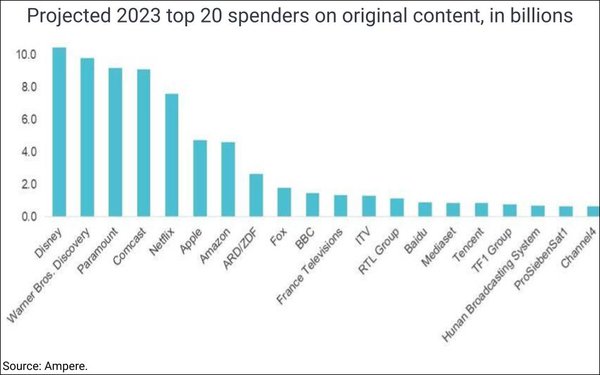
 On a global basis, overall investment in original content for streaming and broadcasting will increase by just 2% in 2023, projects media analyst firm Ampere Analysis. That would be the lowest growth rate in a decade, with the exception of a COVID-driven slump in 2020. In contrast, original content expenditures are estimated to have grown 6%, to $238 billion, in 2022, driven primarily by subscription video-on-demand (SVOD) platforms.
Source: Video Insider: Original Content Spending Growth Forecast To Slump In 2023



 The never-ending supply of new programming that helped define the streaming era appears to finally be slowing. The number of adult scripted series ordered by TV networks and streaming companies aimed for U.S. audiences fell by 24 percent in the second half of this year, compared with the same period last year, according to Ampere Analysis, a research firm. Compared with 2019, it is a 40 percent drop.

 Despite the seemingly constant state of disruption, if we take a step back, very little has fundamentally changed since the first sweep of smartphones dominated the market. The real question is not what the next new smartphone moment will be, but whether there will be one at all. This question should be all the more prominent in the planning of entertainment companies as we watch the tech behemoths begin to shift pace in the face of a global economic crisis.
 Not all digital creators prefer contemporary beats in the background of their content. An increasing number of them are dusting off old tracks for their new videos. Epidemic Sounds’ end-of-year data reveals that its classical music library has now been streamed more than 200 million times, and those pieces appeared in 90% more YouTube videos than in the previous year.